 20Hecto
What if the simple act of taking a photo could replace twenty minutes of manual data entry while providing clinical-grade metabolic insights? For many, the traditional process of searching databases for every individual ingredient is exhausting and unsustainable. It’s difficult to maintain consistency when you’re forced to guess portion sizes or struggle to understand why a specific meal triggered a subsequent glucose spike. You likely agree that tracking should be a tool for empowerment, not a source of daily friction.
This article demonstrates how an AI meal photo logging app transforms your smartphone into a sophisticated metabolic sensor. You'll learn how visual food logging removes the technical barriers to accuracy and provides a data-driven bridge to optimal wellness. We will examine the mechanics of "snap-and-done" logging, the visual correlation between food choices and lab markers like HbA1c, and how to share professional-grade data with your healthcare team. It's time to move beyond manual entry and embrace a high-tech approach to personal optimization and metabolic health.
Key Takeaways
- Identify ingredients and portions instantly using computer vision to eliminate the high abandonment rates associated with manual database entry.
- Utilize an AI meal photo logging app to perform volumetric analysis and uncover hidden nutritional factors like dressings or oils.
- Connect your visual logs to metabolic markers by tracking how specific meals influence glucose spikes and overall glycaemic load.
- Build a comprehensive wellness profile by integrating lab values like HbA1c and lipids with your fasting windows and nutritional data.
- Shift from memory-based reporting to data-driven collaboration by sharing real-time metabolic dashboards directly with your healthcare practitioner.
What is an AI Meal Photo Logging App and Why is it Necessary?
An AI meal photo logging app represents a fundamental shift in how we document nutritional intake. It utilizes computer vision to identify specific ingredients and portion sizes from a single image. This technology moves beyond passive logging, where users simply record data, and transitions into active metabolic oversight. By the end of 2026, industry data suggests that 40% of nutrition apps will include conversational AI coaches. This evolution turns your phone into a methodical partner that provides the necessary data for you to lead your own journey. It’s about removing the barriers between seeing a meal and understanding its biological impact.
The Problem with Manual Food Diaries
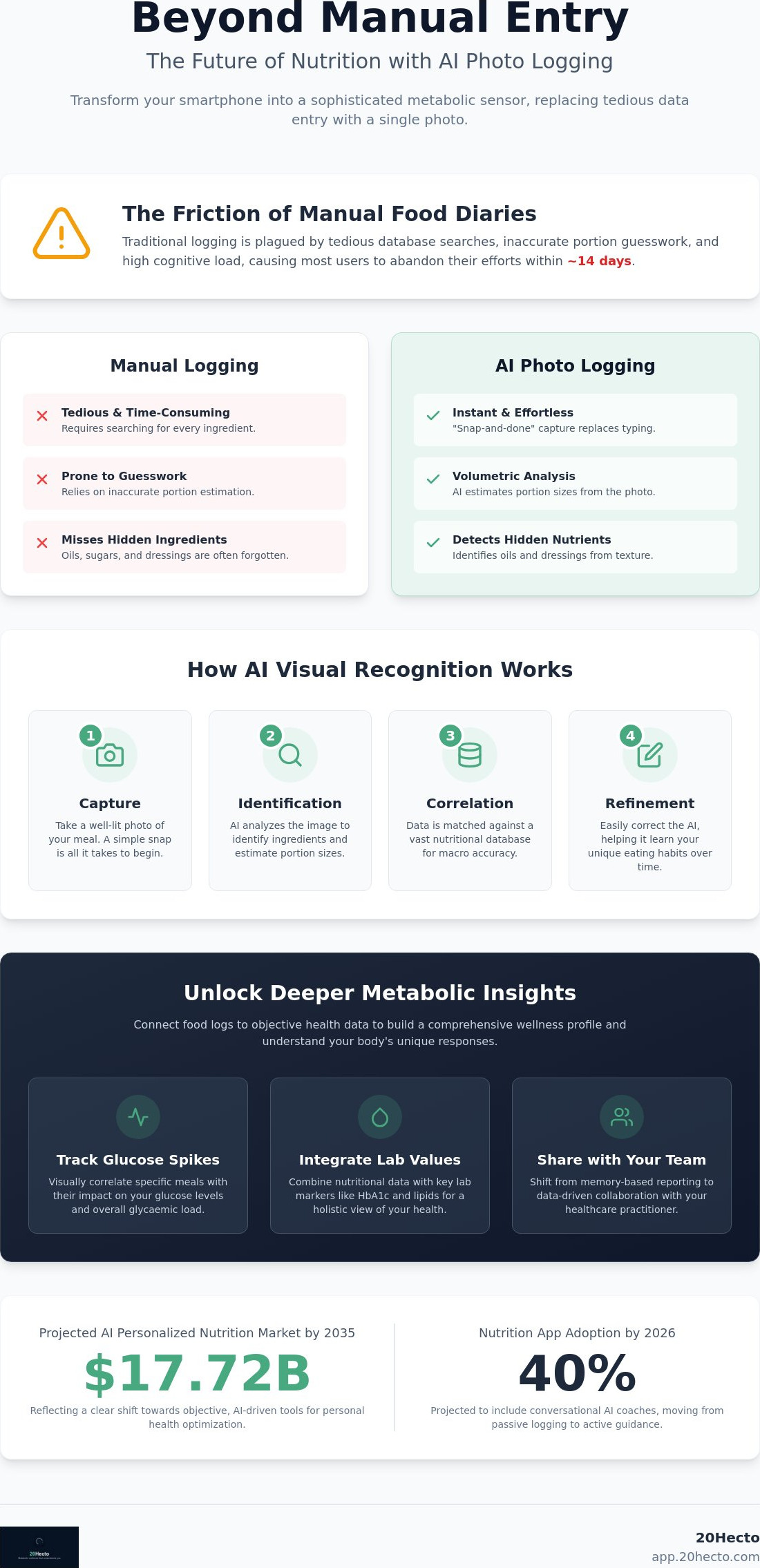
Traditional tracking methods are often unsustainable. Database fatigue is a common result of searching for a simple dish like "chicken salad" and being met with 500 conflicting entries. This leads to decision paralysis. Users often pick the first entry regardless of its accuracy. There’s also the "portion slider" problem. Human estimation of volume is highly subjective and usually incorrect. Because of this high cognitive load and inaccurate feedback, most manual logging efforts stop after 14 days. The friction of manual entry is simply too high for long-term adherence. It’s an exhausting process that rarely yields professional-grade data.
The Solution: Computer Vision and Nutrient Estimation
Advanced neural networks now identify volumetric data from a 2D photo to provide instant nutritional breakdowns. These systems calculate carbohydrates, proteins, fats, and fibre without requiring a kitchen scale. Early iterations seen in some AI-powered meal tracking apps demonstrate how this technology reduces user effort. The system works by analyzing the spatial relationship between objects in the frame. It detects the plate, the food, and the background to estimate size accurately.
AI food recognition is a tool for clinical accuracy without the manual labor. It identifies hidden components like oils or dressings that are often missed in self-reported diaries. This level of precision is driving the AI personalized nutrition market toward a projected $17.72 billion valuation by 2035. It offers a clear path to understanding the direct link between food choices and metabolic results. By capturing data at the source, users gain a transparent view of their nutrition that is both objective and actionable.
How AI Visual Recognition Improves Nutritional Accuracy
Capturing high-fidelity data begins with a single image. An AI meal photo logging app uses depth and scale to perform volumetric analysis. This process relies on Advancements in Using AI for Dietary Assessment to ensure that a 2D photo translates into accurate 3D portion sizes. Proper lighting and a 45-degree angle help the neural network distinguish between plate boundaries and food volume. It’s a methodical approach that replaces the guesswork of human estimation.
The accuracy of this system is built on a structured four-step sequence:
- Capture: Users take a photo with adequate lighting to support volumetric analysis.
- Identification: The AI detects specific ingredients, including hidden fats or oils often missed by human eyes.
- Correlation: The system matches visual data with a global nutritional database for precise macro-accuracy.
- Refinement: A manual override allows you to correct the AI, which helps the system learn your specific dietary patterns over time.
Identifying Hidden Ingredients
Restaurant meals present a unique challenge compared to home-cooked whole foods. Ingredients like butter, sugar, or heavy oils are often invisible to the casual observer. The AI analyzes surface textures and sheen to estimate these additions. For packaged goods, the 20Hecto barcode scanner provides a secondary layer of verified data. This combination allows the system to estimate glycaemic load based on how different ingredients interact within a single meal. This is a critical metric for metabolic health. It accounts for how fats and fibres slow down the absorption of sugars. You can start building your own metabolic data profile to see these specific insights in real-time.
The Role of the AI Nutrition Coach
Nuti, the AI Nutrition Coach, provides immediate feedback once a meal is logged. It moves the conversation from "what did I eat?" to "how should I adjust my next meal?" If a logged lunch is high in refined carbohydrates, Nuti might suggest adding protein or fibre to your dinner to stabilize your glucose levels. Immediate feedback is essential for habit formation. It turns a static log into a dynamic tool for behavioral change. You aren't just recording history; you're receiving actionable guidance to optimize your metabolic health throughout the day. This level of oversight ensures that every data point serves a purpose in your long-term wellness strategy.
Connecting Visual Logs to Metabolic Health and Glucose Spikes
Every meal you log serves as a biological experiment. An AI meal photo logging app provides the necessary context to turn a simple image into a data point for metabolic health. While traditional diaries record what you ate, they rarely explain how that food affected your body. By mapping visual intake directly to physiological responses, you can identify the specific relationship between your plate and your blood glucose levels. This objective oversight is critical for anyone looking to optimize their longevity and prevent metabolic dysfunction.
A recent study Evaluating the Quality and Comparative Validity of nutrition technologies highlights how AI-driven tools offer the precision required for meaningful clinical observation. This level of accuracy allows for the identification of "silent" metabolic triggers. You might find that a seemingly healthy meal, such as a green smoothie or oatmeal, causes a significant glucose spike due to your individual biology. Seeing the photo alongside the data removes the guesswork and reveals the truth about your body's sensitivities.
Blood Glucose and Meal Correlation
Visualizing the glucose curve directly alongside the meal photo provides immediate context for every spike or dip. The "Meal Correlation" tool allows you to scroll through your history and see exactly which ingredients triggered a post-prandial response. This isn't just about avoiding sugar; it’s about understanding how your body handles specific carbohydrates. Tracking these responses over time helps you build a personal library of "safe" meals. It's a proactive approach to health that emphasizes immediate feedback over retrospective analysis. You don't have to wonder why you felt a mid-afternoon energy crash when the data is clearly linked to your lunch photo.
Monitoring Glycaemic Load
Glycaemic load is a more accurate predictor of metabolic health than glycaemic index alone. While the glycaemic index measures how quickly a carbohydrate raises blood sugar, the glycaemic load accounts for the total amount of those carbohydrates in your portion. An AI meal photo logging app calculates this by analyzing the volume of the food on your plate. It looks at the total impact of the meal, including how fats and proteins might be buffering the sugar response. This distinction is vital because it allows for more flexibility in your diet while maintaining metabolic control. Glycaemic load tracking is the key to preventing insulin resistance. By focusing on the total impact of your plate, you can make informed adjustments that support stable energy levels and long-term wellness.
A Comprehensive Dashboard: Labs, Fasting, and Longitudinal Tracking
True metabolic health requires looking beyond isolated daily snapshots. While an AI meal photo logging app provides essential granular data, its real power is realized when those logs are integrated into a longitudinal framework. The transition from simple tracking to a comprehensive Metabolic Wellness Dashboard allows you to observe how daily nutritional choices influence long-term biological markers. It’s about moving from "what happened today" to "how is my health trending over months." 20Hecto visualizes this complex data using intuitive trends and progress markers, making it accessible and actionable for the average user without sacrificing clinical depth.
Tracking Clinical Lab Values
Meal photos provide immediate feedback, but clinical lab values offer the necessary context for long-term health. Monitoring HbA1c, for instance, gives you a three-month average of blood sugar levels that daily logs alone can't provide. Similarly, tracking thyroid panels and lipid profiles ensures a complete picture of your metabolic function. Thyroid function acts as a primary regulator of your metabolic rate, while lipid panels reflect the long-term impact of your dietary fat quality. Centralizing this information within a secure digital environment removes the fragmentation typically found in health records. You can see how a consistent reduction in glycaemic load, captured via your AI meal photo logging app, correlates with objective improvements in your clinical markers over time.
Intermittent Fasting and Metabolic Flexibility
Integrating intermittent fasting schedules with nutritional windows is a critical component of metabolic optimization. The app tracks these fasting windows to help you improve insulin sensitivity and build metabolic flexibility. This flexibility is your body's ability to switch efficiently between burning carbohydrates and burning fat for fuel. By correlating fasting duration with your glucose stability levels, you can identify the optimal timing for your meals. This data-driven approach ensures you aren't just following a generic schedule, but one that works for your unique physiology. You'll see exactly how your body responds to different fasting protocols, allowing you to refine your routine for maximum benefit. This level of oversight turns fasting from a restrictive practice into a strategic tool for health.
Building a complete picture of your health requires a unified view of your labs, fasting, and nutrition. You can access your Metabolic Wellness Dashboard today to start correlating your daily habits with clinical results.
Bridging the Gap: Sharing Data with Healthcare Practitioners
Real-time data sharing replaces the unreliable nature of self-reported "memory" logs. When you use an AI meal photo logging app, you create an objective record that eliminates the guesswork typically found in clinical consultations. Practitioners often struggle with patients who can't accurately recall their intake from several days ago. By providing a direct link to your metabolic dashboard, 20Hecto enables your healthcare provider to review actual food choices alongside physiological responses. This transparency improves the quality of consultations and allows for more precise adjustments to your wellness plan. It’s about moving from anecdotal evidence to a data-driven clinical partnership.
Security remains a primary priority when sharing sensitive biological information. 20Hecto utilizes robust encryption and privacy protocols to ensure your data is only accessible to authorized practitioners. As regulatory bodies like the FTC increase enforcement of health data rules in 2026, using a platform that prioritizes data integrity is essential. You maintain full control over who views your metabolic trends and clinical lab values. This secure environment fosters a sense of trust and oversight, ensuring your personal health information is used only to optimize your results.
Empowering Your Healthcare Team
Providing your nutritionist with a visual history of every meal eaten transforms the diagnostic process. It reduces "recall bias," a common issue where patients unintentionally omit snacks or underestimate portion sizes. Photo evidence provides a ground truth that manual entries can't match. This collaborative health management model ensures you and your doctor are looking at the same dataset. Instead of debating what might've caused a lab value shift, you can examine the specific meals and fasting windows leading up to the blood draw. It creates a methodical partnership based on observation rather than estimation. Your team can see the exact context of your metabolic spikes, leading to more effective interventions.
The 20Hecto Advantage for Metabolic Longevity
A unified approach to health is superior to managing five different apps for nutrition, labs, and fasting. 20Hecto integrates your AI meal photo logging app data with clinical lab values, intermittent fasting schedules, and the Nuti AI Coach. This all-in-one environment provides a cohesive view of your metabolic flexibility and long-term trends. It removes the friction of jumping between platforms and ensures that every piece of data informs the next. You gain a sophisticated digital assistant that is both observant and analytical, providing a sense of calm oversight over your entire journey.
Start your metabolic optimization journey with 20Hecto today.
Take Control of Your Metabolic Future
Transitioning from manual diaries to automated visual tracking is a fundamental step toward sustainable health management. You've seen how identifying hidden ingredients and monitoring glycaemic load provides a level of precision that traditional methods lack. By centralizing your lab values and fasting windows within a single dashboard, you create a comprehensive roadmap for your wellness journey. Utilizing an AI meal photo logging app ensures that every data point is objective, actionable, and ready for clinical review.
The 20Hecto platform offers a unified environment for personal optimization. You gain access to the AI-powered Nuti coach for real-time metabolic insights and integrated tracking for HbA1c, thyroid, and lipid panels. This system also supports direct data sharing with healthcare practitioners for professional oversight, ensuring your medical team has the most accurate information available. It's time to move beyond estimation and embrace a methodical, data-driven approach to your health. Start logging your meals with AI on 20Hecto today to experience the next evolution in nutritional science. Your journey to metabolic flexibility is now supported by the most advanced digital tools available.
Frequently Asked Questions
How accurate is AI meal photo logging compared to manual entry?
AI logging eliminates the subjectivity and error common in manual entry. Manual diaries often fail because users struggle with portion estimation and database fatigue. Computer vision technology provides a more consistent baseline by identifying volume and hidden ingredients. This objective oversight ensures that your data remains professional-grade and useful for clinical analysis. It’s a more efficient way to maintain long-term adherence without the usual friction of typing every ingredient.
Do I need a continuous glucose monitor (CGM) to use 20Hecto?
You don't need a continuous glucose monitor to benefit from the platform's core features. While the Meal Correlation tool is enhanced by CGM data, the system works effectively as a standalone tool. You can still log meals, track lab values like HbA1c, and manage your fasting windows. This provides a comprehensive overview of your metabolic health even without real-time sensor data. It's a flexible solution designed for various levels of health optimization.
Can the app track home-cooked meals without a barcode?
The app identifies whole foods and complex home-cooked meals by analyzing visual textures and volumes. You aren't limited to items with barcodes. The computer vision system recognizes individual ingredients on a plate and estimates their nutritional values based on volumetric data. This allows for accurate tracking of fresh, unprocessed meals that don't come in a package. It's a versatile solution for users who prioritize whole-food nutrition and want to avoid the limitations of barcode scanning.
What lab values should I be tracking for metabolic health?
Monitoring HbA1c is essential for understanding your average blood sugar over a three-month period. You should also track lipid panels to assess cardiovascular health and thyroid markers to monitor your metabolic rate. Centralizing these lab values alongside your nutritional logs allows you to see the direct impact of your lifestyle on your biology. This longitudinal view is critical for identifying trends and making informed, data-driven adjustments to your long-term wellness strategy.
Is my health data secure when sharing with a practitioner?
Data security is a fundamental component of the platform's architecture. All health information is stored using advanced encryption methods to prevent unauthorized access. When you share your dashboard with a practitioner, you're using a secure, professional-grade interface designed for data integrity. The system is built to meet high standards of transparency and privacy. You have the final authority over who can view your clinical markers and meal history at all times.
How does the AI nutrition coach (Nuti) provide advice?
Nuti acts as a data-driven companion that provides immediate feedback on your metabolic choices. It analyzes the nutritional content of your logged meals and suggests improvements based on your specific goals. For example, if a meal is high in refined carbohydrates, Nuti might recommend adding fibre to stabilize your glucose response. This real-time coaching helps you make better decisions in the moment rather than waiting for a retrospective review of your data.
Can I track intermittent fasting alongside my meals?
You can track fasting windows seamlessly alongside your nutritional intake. The integrated intermittent fasting tracker allows you to see how the duration of your fast influences your energy levels and metabolic markers. Correlating these windows with your meal photos helps you identify the optimal timing for your nutrition. This data-driven approach supports the development of metabolic flexibility, allowing your body to switch between different fuel sources more efficiently throughout the day.
Does the app work for people with specific dietary restrictions like Keto or Vegan?
The platform is fully compatible with any dietary preference, including Keto, Vegan, or Paleo diets. An AI meal photo logging app identifies the specific ingredients on your plate regardless of the dietary framework you follow. This allows you to monitor your macronutrients and glycaemic load with precision. Whether you're tracking net carbs for Keto or protein intake for a plant-based diet, the technology provides the objective data needed to lead your own journey.