 20Hecto
How to Integrate Dietary Tracking into Patient Care

Integrating dietary tracking into patient care is the most direct way to close the gap between what patients eat and what clinicians actually know about it. The formal term for this practice is nutritional care integration, and it covers everything from food logging apps to FHIR-based data exchange with electronic health records (EHRs). Routine nursing dietary diaries show only 60.8% concordance with gold-standard meal weighing. That gap costs clinicians the accuracy they need to make sound decisions for patients managing Type 2 diabetes, insulin resistance, or thyroid disorders. Modern AI-based tools and standardized integration protocols now make it possible to capture reliable dietary data at scale, without adding significant burden to clinical workflows.
What tools do you need to integrate dietary tracking in clinical workflows?
The foundation of any dietary tracking integration is a digital food logging system that captures intake data in a structured, clinically usable format. Basic calorie-counting apps do not meet this bar. Clinical-grade tools must output macronutrient breakdowns, glycemic index values, and micronutrient data normalized against validated reference databases — for example USDA FoodData Central for research-grade composition tables, plus large product catalogs such as Open Food Facts (1M+ barcoded items) for real-world packaged foods patients actually buy.
AI-powered food recognition
Photo-based food logging is the most accurate low-burden method available. Intelligent food recognition systems exceed 90% volume estimation accuracy in clinical settings by combining image recognition with therapeutic diet databases. That level of accuracy eliminates the recall bias that plagues traditional 24-hour dietary recall surveys. Patients photograph their meals, and the system returns a full nutrient breakdown in seconds.

Pro Tip: Require any food recognition tool you evaluate to demonstrate accuracy against validated nutrient sources — not just calorie counts. For metabolic patients, prioritize glycemic index, macros, and the ability to combine barcode lookup, AI meal photos, and manual entry with AI estimation when a food is not in any database.
EHR integration standards
Connecting dietary data to an electronic health record (EHR) ultimately requires a standardized data exchange layer. FHIR R4 with middleware is the recommended long-term approach for vendor-agnostic, secure integration. FHIR resources relevant to nutrition include Observation, NutritionOrder, Goal, CarePlan, and the newer RecordedDiet resource. Middleware translates vendor-specific EHR protocols into these standard formats, so the same nutrition app can connect to Epic, Cerner, or other platforms without custom connectors for each site.
Practical note: Many practices start before full FHIR go-live — with a patient app, a practitioner review portal, consent-based sharing, and exportable summaries — then add FHIR Observation / RecordedDiet feeds as the EHR partnership matures. That phased path is valid; the mistake is stopping at a disconnected calorie app with no clinical handoff at all.
The table below shows the key FHIR resources and their clinical function in a dietary tracking workflow:
| FHIR Resource | Clinical Function |
|---|---|
| Observation | Stores individual nutrient data points (e.g., carbohydrate intake per meal) |
| NutritionOrder | Documents prescribed dietary plans and restrictions |
| RecordedDiet | Captures patient-reported food intake from logging apps |
| Goal | Tracks dietary targets such as daily fiber or sodium limits |
| CarePlan | Coordinates nutrition goals within the broader treatment plan |
Building direct EHR API connectors for each vendor is unsustainable. Middleware is not optional for any practice planning to scale beyond a pilot.
How to implement dietary tracking into patient care systems
A structured implementation process prevents the most common failure modes: mismatched data formats, low patient adoption, and clinical staff who do not know how to act on the data they receive.
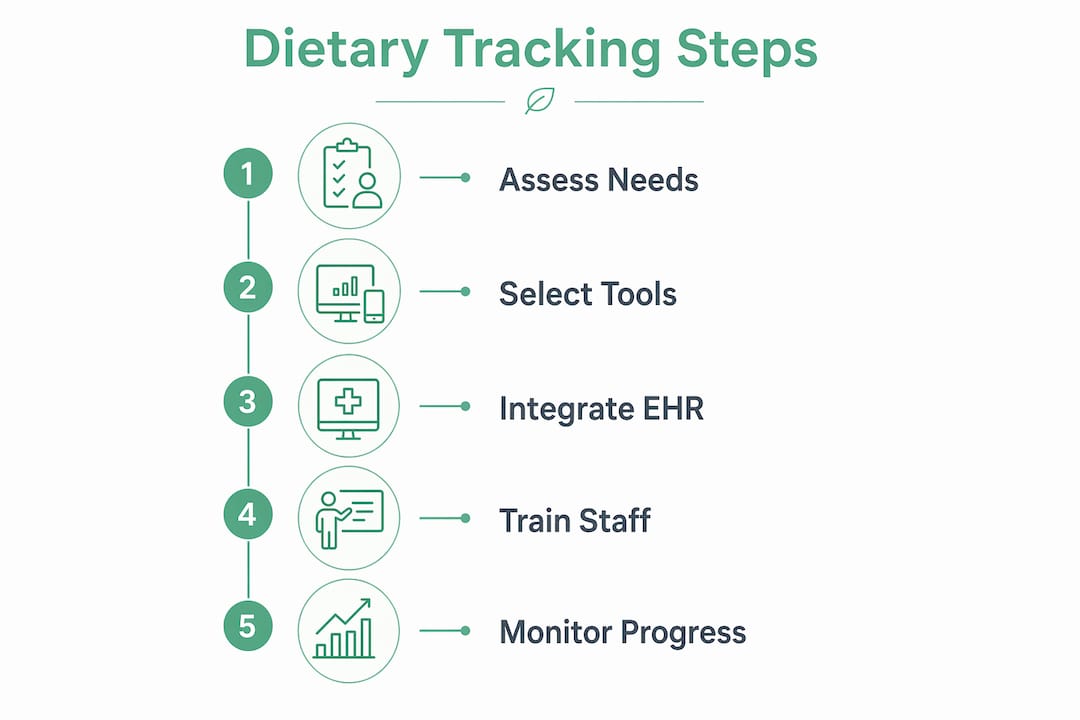
Assess your patient population and clinical needs. Identify which conditions drive the most dietary-related risk in your practice. Patients with Type 2 diabetes, metabolic syndrome, or thyroid disorders benefit most from continuous dietary monitoring. Define the specific data points your clinicians need: HbA1c correlation, glycemic load trends, or micronutrient gaps.
Select compatible technology. Choose a tool that supports photo-based logging, barcode scan, and low-friction manual entry (with AI nutrition estimates when the food is not in a database). Prefer apps that can export structured summaries for clinicians today and publish FHIR-compatible data on your roadmap. Verify nutrient sources: reference tables (e.g. USDA) plus product databases (e.g. Open Food Facts) for everyday foods.
Plan integration in phases. Phase 1: patient logging → practitioner portal or PDF summary → visit prep (e.g. review 7-day trends before telehealth). Phase 2: FHIR middleware so meal logs flow into Observation / RecordedDiet in the chart without manual re-entry. Photo-based logging integrated into visit workflows improves counseling precision even before every field is mirrored inside the EHR.
Train clinical staff. Dietitians, nurses, and physicians need a clear protocol for reviewing dietary data — in the EHR when integrated, or via a practitioner portal / shared summary until FHIR is live. Define who reviews the data, at what frequency, and what triggers a follow-up conversation with the patient.
Educate patients on the tracking tool. A 10-minute onboarding session covering photo logging, portion size guidance, and reminder settings reduces early dropout significantly. Patients who understand why they are logging, not just how, show better long-term adherence.
Establish data review routines and clinical decision support triggers. Set automated alerts for critical thresholds: consecutive days of high glycemic load, sodium intake above prescribed limits, or caloric intake below a safe floor. These triggers convert passive data collection into active clinical intervention.
Pro Tip: Run a 4-week pilot with 10–15 patients before full deployment. Pilots surface EHR mapping errors and patient usability issues at a scale you can fix quickly.
How do you maintain patient engagement in dietary tracking?
Patient engagement is the single biggest variable in dietary tracking outcomes. Food logging engagement declines rapidly after the initial period, and certain periods such as holidays carry documented risk of 0.5–1 kg fat gain alongside tracking dropout. Designing your workflow to anticipate these gaps is more effective than trying to recover engagement after it drops.
The most effective strategies for sustained engagement include:
- Minimize manual input. Photo-based logging requires less effort than text entry and produces more accurate data. When patients must log homemade or restaurant meals, AI-assisted manual entry (describe the dish → estimate calories and macros) beats forcing users to look up grams they do not know.
- Distinguish skipped meals from missing data. Patients fast, skip meals, or eat out without logging. Tools that let users mark a meal as skipped (vs. leaving a blank slot) give clinicians a clearer picture than treating silence as zero intake.
- Use blended tracking. Combining smart device data with minimal self-report increases long-term engagement and supports AI coaching for energy balance tracking. Wearables and continuous glucose monitors fill data gaps during low-logging periods.
- Set personalized, condition-specific goals. A patient managing insulin resistance needs different targets than one managing hypothyroidism. Generic calorie goals do not motivate clinical populations. Specific, measurable targets tied to lab results do.
- Automate reminders at high-risk times. Schedule push notifications before meals and at the start of known low-engagement periods. Reminders work best when they are brief and tied to a specific action.
- Review data with patients during visits. Showing patients their own nutrient trend charts during appointments reinforces the value of logging. Patients who see their data used clinically log more consistently.
"Sustained monitoring during low-engagement periods leverages automated energy intake and expenditure estimates for better adherence." — International Journal of Obesity, 2026
Structured diet data integration also allows clinicians to monitor micronutrient patterns and supplement interactions, which are often invisible without consistent dietary data. Normalize against reference nutrient tables where available, and use large product databases (e.g. Open Food Facts) plus AI estimation for items not yet catalogued — that combination matches how patients actually eat across regions and care settings.
What are the most common pitfalls when integrating dietary tracking?
Technical and clinical pitfalls are predictable. Knowing them in advance prevents the most costly implementation failures.
- EHR vendor-specific protocol conflicts. Not all EHRs implement FHIR R4 identically. Test data flows in a sandbox environment before going live. Middleware configuration errors are the most common cause of missing or duplicated dietary records in the patient chart.
- PHI security gaps. Dietary data is protected health information under HIPAA. Confirm that your nutrition app and middleware provider sign a Business Associate Agreement and that data is encrypted in transit and at rest.
- Incomplete or inaccurate dietary data. Patients skip meals, forget to log, or underreport portions. Build clinical protocols that flag data gaps rather than treating absence of data as zero intake. A 3-day gap in logging is a clinical signal, not a clean record.
- Patient disengagement after the first month. The first 30 days show the highest logging rates. After that, engagement drops without active reinforcement. Assign a care team member to review engagement metrics weekly and reach out to patients whose logging frequency falls below a defined threshold.
- Scaling from pilot to full deployment. Pilots succeed partly because of the attention they receive. Full deployment requires documented workflows, trained staff at every site, and automated monitoring of data quality. LLM-based conversational coaches with FHIR persistence are emerging as a scalable solution for maintaining patient engagement without proportional increases in clinical staff time.
Key takeaways
Integrating dietary tracking into patient care requires reliable capture tools, a clear path from patient app to clinician review (portal first, FHIR when ready), and proactive engagement strategies so data stays continuous—not perfect, but actionable.
| Point | Details |
|---|---|
| AI photo logging beats manual diaries | Routine dietary diaries show only 60.8% concordance with actual intake; AI image recognition exceeds 90% accuracy. |
| FHIR R4 with middleware is the long-term standard | Plan FHIR resources and middleware for EHR scale; start earlier with portal sharing and structured exports |
| Engagement drops fast without design | Anticipate low-engagement periods and use blended tracking with smart devices to maintain data continuity. |
| Embed alerts in clinical workflows | Webhook-driven nutrient alerts and trend dashboards convert dietary data into timely clinical interventions. |
| Normalize with reference + product data | Combine USDA-style reference tables with Open Food Facts (barcode) and AI meal/manual estimates for gaps |
Why nutrition data belongs in the chart, not a separate app
I have watched clinical teams spend months selecting a dietary tracking tool, only to deploy it as a standalone app that never connects to the EHR. The data sits in a silo. Clinicians do not look at it. Patients stop logging within weeks because nothing in their care changes as a result. The technology was sound. The integration was not.
The shift that actually moves outcomes is treating nutrition data the same way you treat lab results: structured, time-stamped, and visible in the patient chart. When a dietitian can pull up a patient's 7-day glycemic load trend before a telehealth visit, the conversation changes. When a physician sees a webhook alert that a diabetic patient has logged three consecutive high-carbohydrate meals, the intervention happens before the next HbA1c draw, not after.
The convergence of omics markers with AI-based dietary tools is the next frontier. Combining omics data with AI dietary tracking transforms food logs from static records into dynamic, molecular-level patient assessments. That is not a distant possibility. It is already entering clinical research. The practices that build clean FHIR-based dietary data pipelines now will be positioned to use that data in ways that are not yet fully defined.
My strongest recommendation: do not wait for the perfect EHR integration. Start with your highest-risk metabolic patients on a tool that captures photo logs, barcodes, glucose, and labs, share summaries with your care team through a consent-based workflow, and add FHIR middleware when your IT pathway is ready. The data you collect in the first six months will teach you more about your patient population than any survey ever could.
— Herve
20Hecto and clinical dietary tracking integration
Clinicians managing metabolic conditions need dietary data that goes beyond calorie counts.
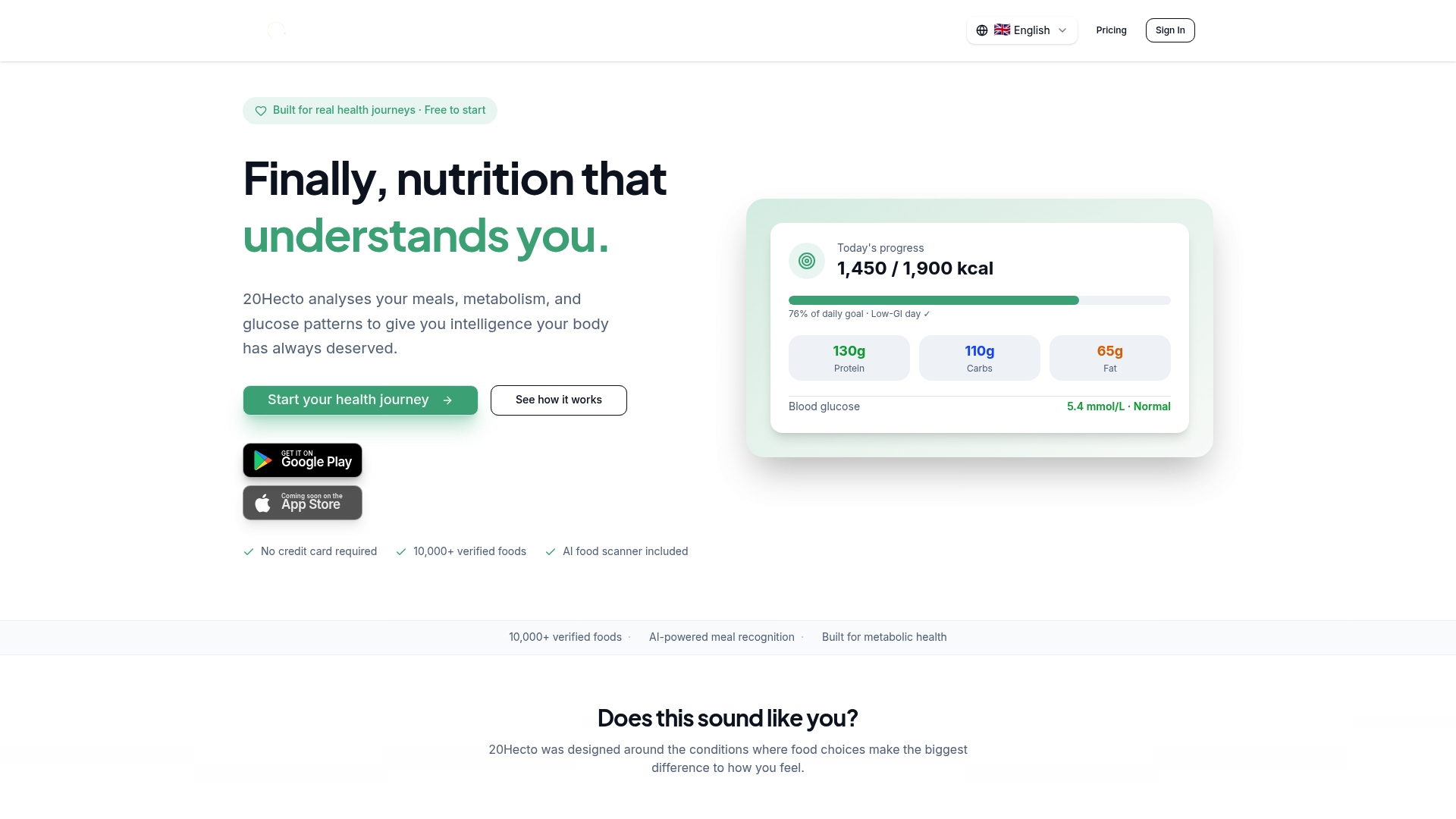
20Hecto is a wellness and nutrition companion (not a medical device or diagnostic tool) built for metabolic health journeys: Type 2 diabetes, insulin resistance, PCOS, and thyroid-related eating patterns. It combines AI meal photo logging, barcode scan (1M+ products via Open Food Facts), AI-assisted manual entry when a food is not in the database, blood glucose and lab tracking, and an AI coach (Nuti) — with clear skip-meal and hydration workflows so gaps in logging are visible, not mistaken for zero intake.
What 20Hecto does today vs. EHR roadmap
| Available today | Roadmap / partner integrations | |
|---|---|---|
| Patient logging | AI meal photos, barcode scan, Quick Add with AI nutrition estimate, meal slots (breakfast, starter, lunch, dinner, snack, dessert), skip-meal reasons | Deeper FHIR RecordedDiet export |
| Metabolic context | Glycemic index on scans, meal ↔ glucose views, daily metabolic score, labs (HbA1c, lipids, etc.) | Automated Observation writes to EHR |
| Practitioner handoff | Patient-initiated consent code sharing; practitioner portal (incl. RPPS verification in France); clinical summary (meals, glucose, labs, meds, trends) | Vendor-specific FHIR middleware (Epic, Cerner, etc.) |
| Engagement | Meal reminders, water reminders that stop at goal, streaks, Food Twin reflections | Webhook alerts into hospital CDSS workflows |
| Data sources | Open Food Facts + AI estimation for unknown foods | Additional reference tables (e.g. USDA) where clinically required |
For practices today: use 20Hecto as the patient-facing log and review the shared clinical summary before visits — without waiting for full EHR plumbing. For hospital IT: treat FHIR R4 (Observation, RecordedDiet, Goal) as the target interface for automated chart integration.
Explore pricing or start at app.20hecto.com.
Clinical disclaimer: 20Hecto supports wellness tracking and care-team collaboration. It does not provide medical advice, diagnosis, or treatment. Clinicians must exercise independent judgment. Always confirm regulatory status (HIPAA BAA, GDPR, local e-health rules) for your deployment.
FAQ
Does 20Hecto integrate with Epic or Cerner today?
20Hecto provides consent-based practitioner sharing and a structured clinical summary today. Direct FHIR write-back into every EHR is the integration roadmap — practices can start immediately with portal review and add middleware when IT is ready.
What does it mean to integrate dietary tracking into patient care?
Nutritional care integration means connecting patient food intake data to clinical workflows and EHR systems so clinicians can act on it. It uses tools like AI photo logging and FHIR-based data exchange to make dietary data as accessible as lab results.
What is FHIR and why does it matter for diet management in patient care?
FHIR (Fast Healthcare Interoperability Resources) is the standard protocol for exchanging health data between apps and EHRs. Using FHIR R4 with middleware allows nutrition apps to connect to any EHR platform without custom-built connectors, making integration sustainable and vendor-agnostic.
How accurate is AI-based dietary assessment for patients?
AI food recognition systems exceed 90% volume estimation accuracy in clinical settings when combined with validated therapeutic diet databases. This is significantly more accurate than traditional self-report methods, which show recall bias and inconsistent portion estimation.
How do you keep patients engaged in dietary tracking long-term?
Blended tracking that combines smart device data with minimal self-report produces the best long-term adherence. Automated reminders, personalized condition-specific goals, and reviewing dietary data with patients during clinical visits all reduce dropout rates.
What are the biggest risks when integrating nutrition tracking into clinical systems?
The most common risks are PHI security gaps, EHR vendor-specific FHIR implementation conflicts, and patient disengagement after the first month. Addressing this requires a Business Associate Agreement with all data vendors, sandbox testing before go-live, and proactive engagement monitoring by the care team.