 20Hecto
AI Nutrition Tracking Advantages for Metabolic Health

AI nutrition tracking is defined as the use of machine learning algorithms, photo recognition, and voice input to analyze dietary intake with greater speed and accuracy than manual food logging. The core ai nutrition tracking advantages are measurable: photo recognition identifies foods with 85–95% top-5 accuracy within 2–10 seconds, and AI reduces portion estimation errors by up to 31.9% compared to manual reporting. For people managing Type 2 diabetes, insulin resistance, or thyroid disorders, these gains are not cosmetic. They translate directly into better data, better patterns, and better decisions. 83% of dietitians now incorporate mobile health apps into practice, signaling that AI-assisted tracking has moved from novelty to clinical standard.
1. How AI photo recognition speeds up meal logging
Photo recognition is the fastest and most widely used method in AI nutrition tracking. You photograph your plate, and the AI identifies each food item, estimates portion size, and returns a full nutritional breakdown in seconds. That process replaces what used to take 3–5 minutes of manual database searching per meal.
The speed gain is real. AI nutrition tracking cuts logging time by approximately 70% compared to manual entry. That shift from minutes to seconds per meal removes the single biggest reason people abandon food journals: friction.
Under the hood, modern apps use convolutional neural networks trained on millions of labeled food images. Some platforms also apply monocular depth estimation and plate geometry algorithms to reconstruct food volume from a single photo. That technique improves portion weight calculations without requiring a food scale.
- Photograph your meal from directly above at a 45-degree angle for the clearest item separation.
- Use natural light when possible. Shadows distort color and shape, which reduces recognition accuracy.
- Log mixed dishes (stews, casseroles) as individual components when you can identify them separately.
- Voice input works well for simple items like “one medium apple” or “two eggs scrambled” when photographing is inconvenient.
Pro Tip: Place a coin or fork next to your plate before photographing. The AI uses that reference object to calibrate portion volume, which is the step that most directly reduces estimation error.
2. Personalized metabolic insights beyond calorie counting
Standard calorie counting treats a bowl of white rice and a bowl of lentils as nearly equivalent. AI nutrition tracking does not. It integrates personal data including weight, age, activity level, and metabolic markers to generate recommendations specific to your physiology.

For people managing insulin resistance or Type 2 diabetes, the most relevant metric is glycemic load, not total calories. AI tracking is evolving toward precision nutrition by integrating continuous glucose monitor (CGM) data and other metabolic markers to deliver real-time feedback instead of historical calorie summaries. That shift changes how you use the data. Instead of reviewing yesterday’s intake, you see how this morning’s breakfast is likely to affect your blood sugar within the next two hours.
Adaptive learning makes the system more useful over time. The AI observes which foods correlate with blood sugar spikes in your data specifically, not population averages, and adjusts its recommendations accordingly. A food that works well for most people may not work for you, and the system learns that distinction.
“Explainability of AI recommendations is critical to user trust. Apps should provide data source transparency and a clear rationale for every nutritional recommendation.” — Implementation and Applications of Artificial Intelligence in Nutrition, MDPI Nutrients 2026
Explainability drives clinical adoption of AI nutrition tools. When you can see why the app flagged a meal, you are far more likely to act on the recommendation. Opacity breeds skepticism, and skepticism leads to abandonment.
3. Voice logging as a practical alternative input method
Voice input fills the gap that photo logging cannot cover. Packaged foods, restaurant meals with complex sauces, and drinks consumed away from a table are all easier to log verbally than photographically. You speak the item name, quantity, and preparation method, and the AI parses that into structured nutritional data.
Voice logging is not as accurate as photo recognition for mixed dishes, but it is significantly faster than manual text entry. The practical benefit is consistency. A log with minor estimation errors is more useful than a log with large gaps. Partial data beats no data every time.
The best approach combines both methods. Photograph whole meals at home where lighting and plating give the AI the most to work with. Use voice input for snacks, drinks, and meals eaten on the go. That combination keeps your log complete without adding meaningful time to your day.
4. How food photography tracks nutrition for mixed and regional dishes
Mixed dishes present the hardest challenge in meal photo nutrition logging. A curry, a burrito, or a stir-fry contains layered ingredients that overlap visually. AI systems handle this by decomposing the image into probable components and cross-referencing against known dish recipes in their database.
Regional database optimization significantly improves accuracy for culturally specific cuisines. An AI trained primarily on Western food images will underperform on dishes from South Asian, East Asian, or Latin American cuisines. Apps that train on localized datasets close that gap. If you eat a diet heavy in regional cuisine, database coverage is the single most important feature to evaluate before choosing a tracking tool.
Continuous user feedback improves recognition over time. When you correct a misidentified ingredient or adjust a portion estimate, the system learns from that correction. Over weeks of use, the AI becomes more accurate for your specific eating patterns and food environment.
5. Meal photography nutrition tracking benefits for diabetes management
Meal photo nutrition logging for diabetes management delivers three specific benefits that manual logging cannot match: glycemic index data per food item, meal-level glycemic load calculations, and pattern detection across days and weeks.
Glycemic index tells you how fast a food raises blood sugar. Glycemic load adjusts that number for portion size. Both metrics require accurate food identification and portion estimation, which is exactly what photo recognition provides. Manual logging typically captures calories and macronutrients but misses glycemic data entirely because most people do not look it up.
Pattern detection is where AI creates the most clinical value. When your app has 30 days of meal photos linked to glucose readings, it can identify that your blood sugar spikes consistently after certain breakfast combinations but not others. That finding is not obvious from reviewing individual meals. It requires the kind of cross-meal analysis that AI performs automatically and that no manual journal can replicate at scale.
6. Challenges in AI portion estimation and how to work around them
Portion size estimation remains the primary source of error in AI food recognition. Food identification is largely solved. Portion volume is not. A pile of pasta photographed from above looks different depending on bowl depth, camera angle, and lighting, and the AI must infer three-dimensional volume from a two-dimensional image.
The practical workaround is consistency. If you photograph every meal from the same angle and distance, the AI’s estimation errors become systematic rather than random. Systematic errors are far easier to correct for when reviewing trends.
Here are four practices that improve AI accuracy over time:
- Use the same plate or bowl for most meals at home. The AI learns your container sizes and uses them as calibration references.
- Correct the AI every time it misidentifies an ingredient. Each correction trains the model on your food environment.
- Weigh high-calorie-dense foods like nuts, cheese, and oils occasionally. Use those measurements to calibrate your visual estimates.
- Focus on weekly averages rather than individual meal precision. A 10% error on one meal matters far less than a consistent 10% error across every meal for a month.
Pro Tip: Do not abandon tracking because a single meal estimate looks wrong. Long-term trend observation is more valuable than single-meal precision. The pattern across 30 days is what drives meaningful dietary change.
7. Why adherence matters more than raw accuracy
Photo logging adherence is 2.3x higher than manual text entry adherence. That single statistic reframes the entire accuracy debate. A tracking method that people actually use consistently outperforms a theoretically more accurate method that people abandon after two weeks.
The reason photo logging sustains engagement is friction reduction. Opening a camera is faster than opening a search field, typing a food name, selecting from a list, adjusting serving size, and saving. That difference in effort compounds across three meals a day, seven days a week. Over a month, the simpler method produces a far more complete dataset.
For people managing chronic metabolic conditions, dataset completeness is not optional. Gaps in your food log create gaps in your pattern analysis. A missed meal is not just a missing data point. It is a missing link in the chain connecting your diet to your blood sugar, energy levels, and symptom patterns.
8. Evaluating AI nutrition tracking tools for metabolic health
Not all AI nutrition tracking tools are built for metabolic health management. General-purpose calorie counters focus on weight loss through energy balance. Tools built for metabolic conditions track glycemic index, glycemic load, macronutrient ratios, and ideally integrate with glucose monitoring devices.
| Feature category | Why it matters for metabolic health |
|---|---|
| Glycemic index and load tracking | Directly relevant to blood sugar management in diabetes and insulin resistance |
| CGM or glucose data integration | Connects meal data to real-time metabolic response |
| Regional food database coverage | Ensures accuracy for your actual diet, not a generic Western food model |
| Adaptive personalization | Improves recommendations based on your specific metabolic patterns |
| Explainability of recommendations | Builds trust and supports informed decisions rather than blind compliance |
Entry-level calorie tracking apps cover the first column poorly and skip the remaining four entirely. Platforms built specifically for metabolic conditions prioritize all five. The gap between those two categories is significant for anyone whose health depends on more than calorie balance.
Key takeaways
AI nutrition tracking delivers its greatest value when used consistently over time, with photo logging as the primary input method and metabolic markers as the primary output focus.
| Point | Details |
|---|---|
| Photo recognition accuracy | AI identifies foods with 85–95% top-5 accuracy and cuts logging time by approximately 70%. |
| Portion estimation limits | Errors in volume estimation are the main AI weakness; reference objects and consistent angles reduce them. |
| Metabolic health specificity | Glycemic load tracking and CGM integration separate metabolic-focused tools from general calorie counters. |
| Adherence beats accuracy | Photo logging users stick with tracking 2.3x longer than manual entry users, producing more complete data. |
| Trend analysis over precision | Long-term dietary patterns reveal more clinically useful information than any single-meal estimate. |
What I’ve learned from watching people use AI nutrition tracking
I have spent years watching people adopt and abandon nutrition tracking tools. The pattern is consistent. People who treat AI nutrition tracking as a precision instrument get frustrated and quit. People who treat it as a pattern-detection system get results and keep going.
The technology is genuinely good at identifying what you ate and roughly how much. It is not a laboratory instrument. Expecting laboratory precision from a phone camera pointed at a plate is the wrong frame entirely. The right frame is: does this tool help me see patterns I could not see before?
For people managing insulin resistance or Type 2 diabetes, the answer is almost always yes. The connection between specific meals and blood sugar responses is invisible without data. AI tracking makes it visible. That visibility is the entire point.
The future I find most interesting is the feedback loop between AI meal analysis and continuous glucose monitoring. When your app knows what you ate and your CGM knows how your blood sugar responded, the system can learn your individual metabolic fingerprint. That is not population-level nutrition advice. That is personalized guidance built from your own biology. We are close to that being standard, not experimental.
My honest recommendation: start logging consistently for 30 days before evaluating whether the tool is working. The first week of data tells you almost nothing. The fourth week tells you a great deal.
— Herve
20hecto brings AI nutrition tracking to metabolic health
20hecto is built specifically for people managing Type 2 diabetes, insulin resistance, and thyroid disorders. You photograph your meals and receive nutritional data that goes beyond calories: glycemic index, glycemic load, and macronutrient breakdowns tied directly to your metabolic profile.
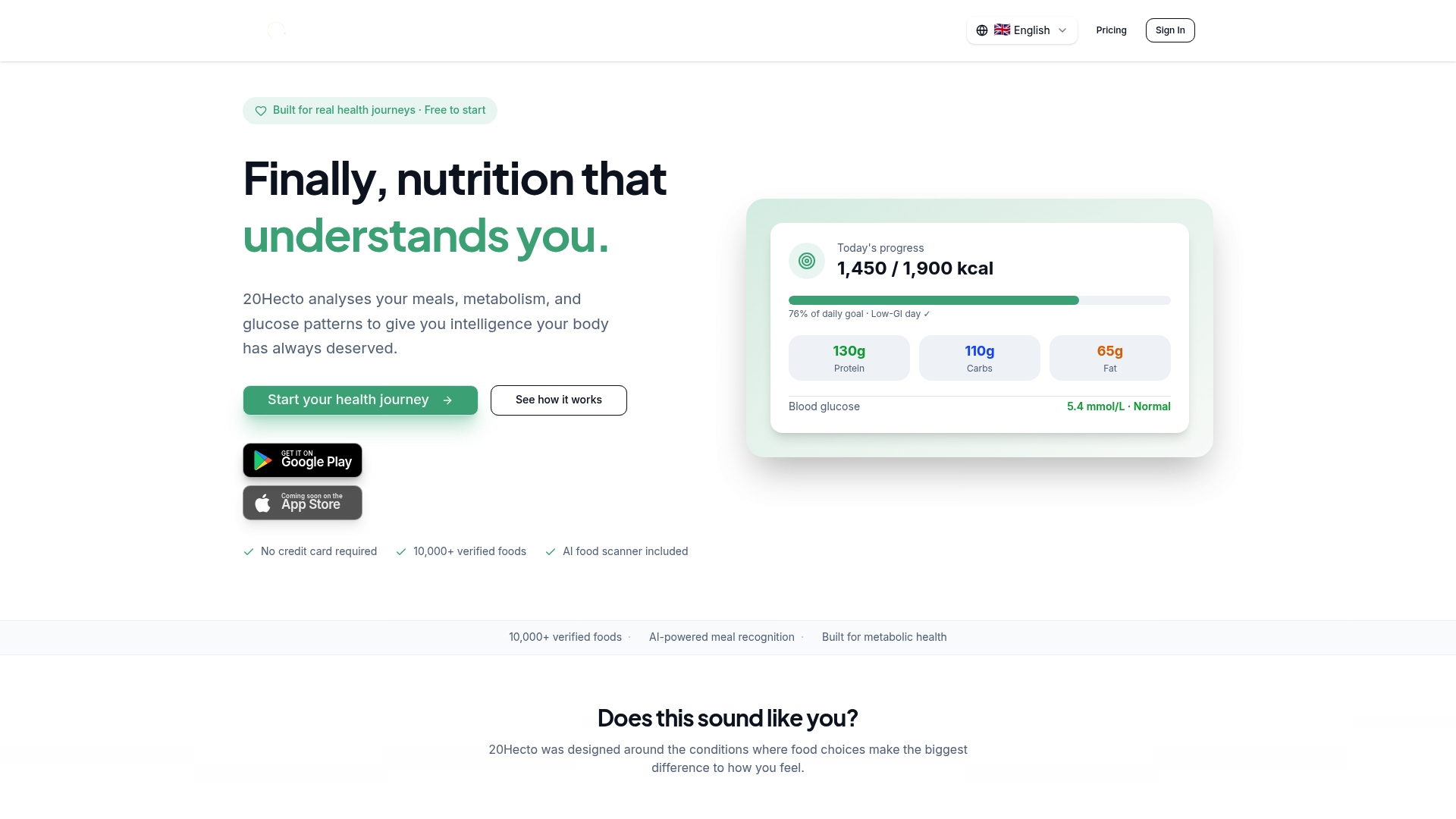
The platform integrates glucose tracking with meal data so you can see correlations between what you eat and how your blood sugar responds. That connection is what separates 20hecto from general-purpose calorie counters. Personalized insights improve as the system learns your patterns over time. Explore the 20hecto nutrition dashboard to see how it fits your health management routine, or review available pricing plans to find the right tier for your needs.
FAQ
What are the main AI nutrition tracking advantages?
AI nutrition tracking identifies foods with 85–95% accuracy, reduces logging time by approximately 70%, and provides glycemic index and load data that manual logging typically misses. For people managing metabolic conditions, those three advantages directly support better dietary decisions.
How does AI photo recognition work for meal logging?
The AI analyzes your meal photo using a convolutional neural network trained on millions of food images, identifies each item, estimates portion volume using depth algorithms, and returns a full nutritional breakdown within 2–10 seconds.
Is AI nutrition tracking accurate enough for diabetes management?
AI tracking is accurate enough to identify meaningful dietary patterns when used consistently. Portion estimation remains imperfect, but long-term trend data from consistent logging is more clinically useful than occasional precise measurements.
How does meal photo nutrition logging help with insulin resistance?
Meal photo logging captures glycemic load data per meal and links it to glucose readings over time, revealing which specific foods and combinations trigger blood sugar spikes in your individual physiology.
Why do people stick with photo logging more than manual entry?
Photo logging adherence is 2.3x higher than manual text entry because photographing a meal takes seconds while manual database entry takes several minutes. Lower friction produces more complete logs and better long-term data.